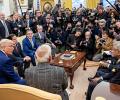
During the talks, India and the US decided to take a big leap in broad-basing their strategic ties in several critical areas.

Brave statements such as we will continue to be the fastest growing large country are of no consolation, because the direction of trade also determines the flow of investment, points out M Govinda Rao.

India and Italy on Tuesday set themselves a target of achieving five billion euro of bilateral trade in next two years.

India and the United States will finalize the contours, schedule of negotiations, and terms of reference for a proposed bilateral trade agreement (BTA) during a three-day meeting beginning Tuesday. The agreement is expected to be finalized in two tranches, with the first phase focusing on goods trade. The US team, led by Assistant US Trade Representative for South and Central Asia Brendan Lynch, will be in India from March 25-29 to discuss the agreement. Both countries are aiming to conclude the first phase of the agreement by fall 2025.
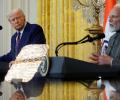
The deal fell through over unresolved disagreements over contentious issues, mainly on agriculture and automotive sector tariffs.

India is far behind global competitors such as Vietnam, Taiwan, and Mexico in increasing electronics exports to the US by making the most of Washington's tariff action against China. In 2018, the US imposed a 25 per cent punitive duty on a range of Chinese electronics items. The trade duties led to a sharp fall in Chinese electronics exports to the US from $207 billion in 2018 to $140.2 billion in 2019, down 32 per cent, according to Indian Cellular and Electronics Association (ICEA) data, which has been analysed by ITC Trade Map.

Japan is expected to increase its investment target in India from the earlier 5 trillion yen ($34 billion) to almost 10 trillion yen.

Trump claimed that he "got a call from Prime Minister Modi saying, 'we're done'. I said, 'you're done with what?'" Trump said and claimed Modi replied: "We're not going to go to war."
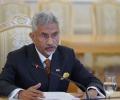
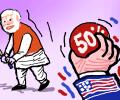
The relations between New Delhi and Washington are on a downturn after Trump doubled tariffs on Indian goods to a whopping 50 per cent, including 25 per cent additional duties for India's purchase of Russian crude oil.
'The government is actively engaging with EU to ensure that concerns of Indian companies and hard-to-abate sectors are adequately addressed under CBAM'

'Should China's interest in the Teesta River projects be approved, it would likely result in heightened Chinese presence near the Siliguri corridor.'
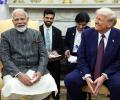
The lawmakers slammed opposition leaders over their remarks on the development, alleging that they were "happy" with the US government's move when "everyone" should be standing together in such a situation.
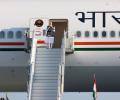
The Kananaskis gathering on June 16-17 is the Prime Minister's 6th consecutive participation in the G7 Summit.

The Indian government has expressed its disagreement with the IMF staff's 'baseline' assumption that the 50 per cent US tariffs on its goods exports 'would remain in place indefinitely', based on which the staff pegged the country's GDP growth at 6.6 per cent this year, and pared its 2026-27 projection by 20 basis points to 6.2 per cent.
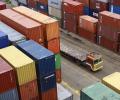
The US Trade Representative noted that India's average applied tariff rate stood at 17% per cent, the highest of any major world economy.
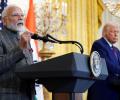
Prime Minister Narendra Modi said on Thursday that India and the United States have set a $500 billion target for bilateral trade by 2030 and added that the teams of two nations will work together to finalise a mutually beneficial trade agreement.
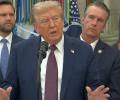
"I understood tariffs better than any human being in the world. And now with my tariffs, they were all dropping them. India was the most highly tariffed nation... And you know what, they've offered me no tariffs in India anymore. No tariffs," Trump said.

New Delhi, while opting not to retaliate yet to the American tariffs, has in recent weeks sought to reinforce its friendship with Moscow, and recalibrate its ties with Beijing rather than surrender to Washington's diktats.

'The US slump could hit our hosiery market hard since 40 per cent of our exports go there.' 'Job losses could be severe if the government doesn't step in fast.'
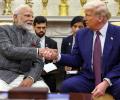
'I certainly hope the two can avoid a trade war and believe they will.' 'I expect some in India will push for retaliatory tariffs if the Trump administration applies significant reciprocal tariffs.'
'Things may get much worse before they get better,' predicts Ajay Chhibber.

The deal was signed between Commerce and Industry Minister Anand Sharma and Japanese Foreign Minister Seiji Maehara in Tokyo.

US President Donald Trump has repeated his claim of "stopping" the conflict between India and Pakistan through trade and tariffs, and suggested he deserves the Nobel Peace Prize for settling multiple conflicts.
India and South Korea have set an ambitious target of $10 billion bilateral trade by 2008 and are exploring new opportunities of cooperation in wide areas like information and communication technology, External Affairs Minister K Natwar Singh said on
'As negotiations continue, the path forward demands not only diplomatic skill, but also vigilance against legal asymmetries embedded in America's trade playbook.'
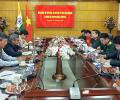
The 15th India-Vietnam Defence Dialogue signalled a move from routine talks to deeper cooperation, with new deals on submarine rescue and defence industry to support stability in the Indo-Pacific, notes Dr Rajaram Panda.
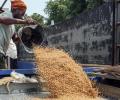
Very sensitive items -- such as apples, which carry political weight and are closely tied to farmer interests in states like Himachal Pradesh and Uttarakhand -- may face restricted concessions.
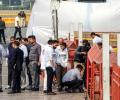
US Secretary of State Marco Rubio praises India's measured and professional investigation into the Red Fort car explosion, calling it a terrorist attack. The US has offered assistance, but acknowledges India's capabilities in handling the investigation.

India and Turkey have agreed to take trade beyond $5 billion target
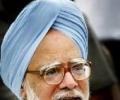
As India and Russia set an ambitious trade target of $20 billion by 2015, Prime Minister Manmohan Singh has asked industry captains from both sides to work for enhancement of economic relations to take them to the level of close political ties shared by the two countries.

The objection based on the fear that domestic industry in Pakistan would be swamped by imports from India is specious.

The firing exchanges are taking places in five districts out of seven border districts of Jammu and Kashmir. So far, there has been no firing reports along International Border in Samba and Kathua districts.

'Pakistan has found itself in a favourable position after Operation Sindoor by appreciating the mediation as claimed by Trump and recommending him for the Nobel Peace Prize.'

Former White House trade advisor Peter Navarro accuses India of being an 'oil money laundromat' for Russia, alleging that India's oil purchases are funding Putin's war in Ukraine. The accusations come amid existing trade tensions and tariffs imposed by the US.
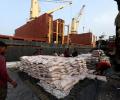
March 31 marked 10 years since the Modi government introduced its first Foreign Trade Policy (FTP 2015-20) that lasted for 8 years before the current FTP 2023 came in. Here is a brief assessment. In 2015, the government said that it aims to increase India's exports of merchandise and services from $465.9 billion in 2013-14 to approximately $900 billion by 2019-20 and to raise India's share in world exports from 2 per cent to 3.5 per cent.

The Global Times, a prominent state-run Chinese media outlet, published an article titled "China and India are cooperation partners, not rivals: Xi," highlighting President Xi Jinping's remarks about the bilateral meeting, saying, "as long as the two countries stick to this overarching direction, China-India relations can sustain steady and long-term growth."
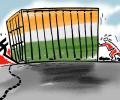
The rising dependence on discounted crude oil has resulted in India's trade deficit with Russia hitting the second-highest place last year, after China, reveals Department of Commerce data. From April through January 2022-23 (FY23), India's maximum trade deficit was with China, at $71.58 billion. This was followed by Russia, where the deficit expanded sevenfold - from $4.86 billion in April-January of 2021-22 (FY22) to $34.79 billion during the same period in FY23.

Prime Minister Narendra Modi is visiting Japan and China to further national interests and build cooperation for regional and global peace.
